Ready to bring thoughtful technology into your kitchen? Explore our kitchen remodeling in Orlando services or contact our team to start planning your project.
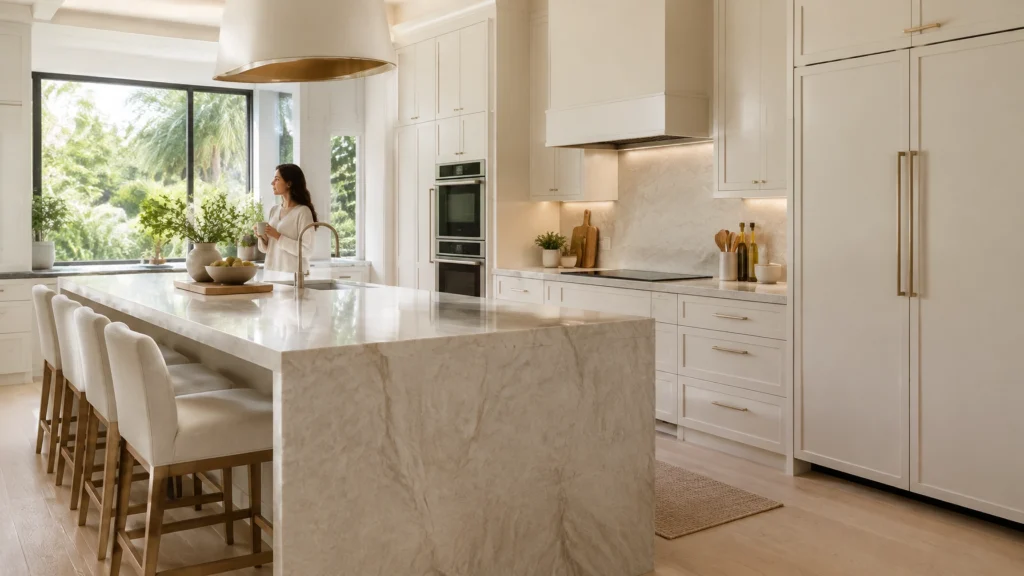
Morning light spills across the island. The oven is warming while you finish your coffee, task lighting brightens the countertop, and the ventilation is ready for breakfast. A well-designed smart kitchen doesn’t need to feel like a control room. The best technology works quietly in the background, making your home more comfortable, convenient, and distinctly yours.
For Orlando homeowners considering kitchen remodeling, the remodel itself is an ideal time to plan the technology. Wiring, outlets, ventilation, and appliance locations all affect what your connected kitchen can do. With a clear plan, you can create a welcoming space that blends craftsmanship with modern convenience.
Start with the routines you want to improve
Before choosing devices, picture an ordinary day in your future kitchen. Do you want to preheat the oven while finishing another task? Get an alert when a dishwasher cycle ends? Turn on a gentle pathway light for an early morning glass of water?
These everyday moments are a practical starting point. Connected ovens may offer remote status checks and alerts, while smart refrigerators and dishwashers can provide notifications or maintenance reminders. Features vary by model, so check what a specific appliance supports, and whether the functions you care about work in the manufacturer’s app or your preferred smart-home platform.

For a cohesive look, consider appliance dimensions, door clearances, ventilation needs, and access to service connections as you develop your layout. Thoughtfully planned custom kitchen cabinets Orlando homeowners choose can help accommodate built-in appliances while preserving useful storage and a clean visual rhythm.
Choose a smart-home setup that stays simple
A connected kitchen may include products from different brands. A shared standard such as Matter can help compatible devices communicate across supported smart-home platforms. Still, compatibility is specific to each model and feature. Confirm the exact product’s support before you buy, and keep the manufacturer’s app available when it provides functions that shared platforms don’t.
Voice and app controls can be useful for checking appliance status, adjusting lighting, or setting a timer. But the essentials should remain easy to use by hand. A wall switch, faucet handle, and appliance controls are valuable even when your phone is elsewhere, or your network is temporarily unavailable.
Aim for convenience, not complexity. A few reliable routines that suit your household are usually more useful than a long list of automations no one remembers how to manage.
Make lighting adapt from breakfast to evening
A thoughtful lighting plan uses more than one source. Combine bright, well-placed task lighting over work surfaces with comfortable ambient light and a softer option for evenings. Dimmable LEDs and smart controls can help you shift between scenes: a bright morning setting, a relaxed dinner glow, and a low-level night path.

You can also select warmer, lower light in the evening and clearer light for food preparation. These scenes can support your routine without relying on sweeping promises about health effects. Lighting needs are personal, and safe visibility at the counter should always come first.
Plan controls where you’ll naturally reach for them. Local switches and dimmers make lighting practical for everyone at home, while voice or app controls add another convenient option.
Plan the network while the walls are open
Smart features depend on a dependable connection. Renovation is the right moment to discuss Wi-Fi coverage, access-point locations, and any low-voltage wiring with your project team. Once finishes are complete, adding a cable route or moving an outlet can be more disruptive.
Think about where the refrigerator, oven, lighting controls, and any smart-home hub will sit. Keep network equipment out of enclosed metal cabinetry and away from locations that are likely to be exposed to heat or moisture. If you use a separate network for smart devices, make sure it still allows the connections your chosen system requires; Matter devices, for example, need to communicate with their controllers and other local devices.
Reliable Wi-Fi is helpful, but it should not be the only way to use essential kitchen functions. Keep manual controls accessible, and consider backup power for the router or hub if maintaining connectivity during a short outage matters to you.
Add useful details: faucets, outlets, and charging
Touchless faucets and other sensor-operated fixtures can make cleanup feel more convenient, particularly when your hands are full. Compare how a fixture is powered, how its manual controls work, and whether replacement parts are readily available. A simple, serviceable product may be a better fit than one with features you’re unlikely to use.
Smart outlets and built-in charging stations can help keep phones and tablets close without letting cords take over the island. Plan their location around splash zones, seating, and everyday countertop tasks. Smart plugs are intended for appropriate devices, not as a substitute for properly designed circuits for major appliances or cooking equipment.

Connect ventilation and air-quality planning
A smart kitchen should feel comfortable as well as connected. Cooking can add moisture and particles to indoor air, so ventilation deserves attention alongside appliances and lighting. The EPA’s indoor-air-quality guidance emphasizes source control and ventilation as practical ways to improve indoor air.
Discuss a range hood that captures cooking emissions and exhausts outdoors, with its size and installation suited to your cooktop and home. A humidity or air-quality sensor can provide useful information, but it does not replace a properly designed hood or sensible ventilation habits.
Central Florida’s warm, humid climate also makes location and moisture management important. Avoid placing sensitive electronics where they are likely to encounter direct splashes, persistent steam, or trapped heat. Choose suitable fixtures and enclosures, keep sensors accessible, and consider monitoring humidity in areas where moisture could affect materials or equipment. UF/IFAS offers guidance on indoor air quality and energy in Florida homes.
Use energy data to make informed choices
Energy monitoring can show how household use changes throughout the day. That information may help you understand the contribution of appliances, lighting, or dehumidification during hot Florida summers. Some homeowners prefer a whole-home view; others want more detail by circuit. Ask a qualified professional about panel compatibility, installation, and the data the system actually provides.
Consider efficient appliances and LEDs, but keep comfort and ventilation in balance. Energy information is most useful when it helps you make decisions, such as adjusting a routine or identifying an unexpected change, not when it creates another dashboard you never check.
Plan for Florida outages and everyday reliability
Hurricane season is a reminder that connected features depend on power. Surge protection and a battery backup for selected essentials, such as network equipment or a few lights, may help your household stay informed through a brief interruption. A properly planned backup system can be discussed with the appropriate licensed professional.
Keep expectations practical: many smart appliances need power to provide connected features, and a battery backup will not necessarily keep every device running. Manual operation, accessible switches, and a clear plan for food safety remain important. Ready.gov’s power outage guidance offers household preparedness information.
Bring the vision together with a clear project plan
Successful modern kitchen remodeling in Orlando is about thoughtful choices, not filling every surface with technology. Start with your daily routines, prioritize dependable essentials, then select connected features that fit your household and design. Make room for service access and manual operation, too. A beautiful kitchen should remain comfortable and usable if an app, router, or sensor needs attention.
At A&G General Services USA, we approach home remodeling in Orlando as a collaborative journey, with careful planning, precise craftsmanship, and clear communication. That includes coordinating the design and keeping project scope transparent. Plumbing, electrical, and gas work must be completed by appropriately licensed professionals; we keep responsibilities clear as the project is planned. If your vision also includes a durable, cohesive floor finish, explore our flooring renovation Orlando services.
Your kitchen can welcome technology without losing its warmth. With a thoughtful layout and the right details, the everyday becomes easier, and the heart of your home feels even more like yours.
Ready to plan a connected kitchen that fits your home and routines? Explore kitchen remodeling in Orlando or contact A&G General Services USA to request a free in-home estimate.
📞 407-572-1830 (FREE Estimate provided)
📲 Follow @ag_general_services
🌎anggeneralservicesusa@gmail.com
#kitchenmakeover #kitchenremodel #kitchengoals #homedesign #renovationexperts constructioncompany